
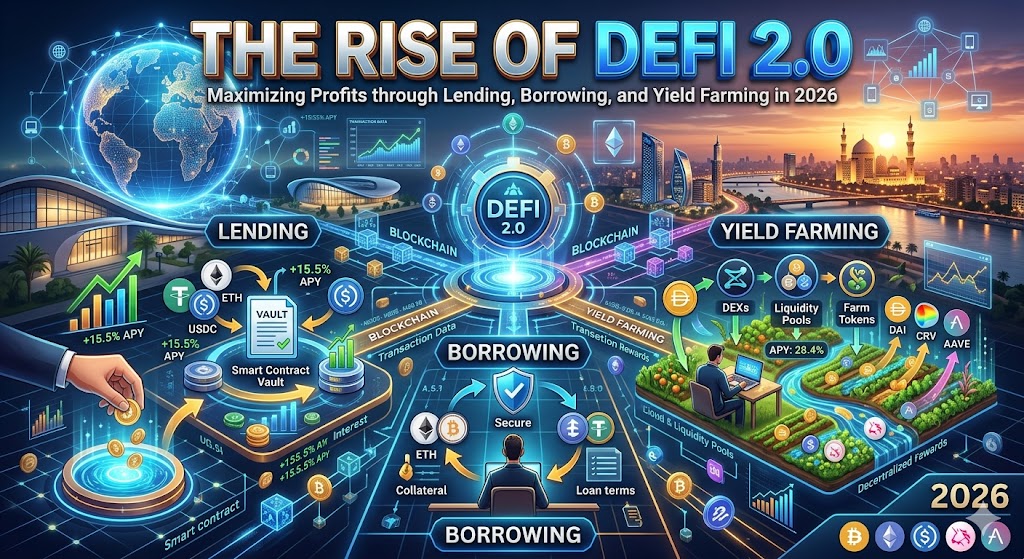
The Rise of DeFi 2.0: Maximizing Profits through Lending, Borrowing, and Yield Farming in 2026

Introduction
The evolution of finance has reached a critical tipping point. In 2026, Decentralized Finance (DeFi) has matured from a experimental niche into a sophisticated $300 billion ecosystem. Unlike traditional banking, which relies on intermediaries and slow settlement times, DeFi 2.0 utilizes Smart Contracts to automate lending, borrowing, and asset management. For investors, this represents a frontier of “Unbanked Wealth,” where yields are not dictated by central banks but by market demand and liquidity protocols. In this 3,000-word guide, we will explore the mechanisms of Yield Farming, the risks of Liquidity Provision, and the advanced strategies that professional DeFi traders use to generate passive income in 2026.
Why DeFi Content is an AdSense Powerhouse
The DeFi niche is one of the most profitable for publishers. Keywords like “DeFi Lending Rates,” “Best Yield Farming Platforms,” and “Smart Contract Audit Services” command exceptionally high CPCs. Advertisers in this space include:
-
Blockchain Security Firms: Offering audit services for new protocols.
-
Crypto Lending Platforms: Competing for users who want to deposit stablecoins.
-
DEX (Decentralized Exchanges): Looking for liquidity providers. By providing deep-dive technical content, your WordPress site becomes a high-value asset for Google’s premium ad networks.
The Core Mechanisms of DeFi 2.0
To understand DeFi, one must understand how it replaces a bank. In a traditional bank, you deposit money, and the bank lends it to someone else, keeping most of the interest. In DeFi, you are the bank.
1. Liquidity Pools and AMMs
Automated Market Makers (AMMs) like Uniswap V4 allow users to swap assets without a central order book.
-
Liquidity Provision: Users deposit pairs of tokens (e.g., ETH/USDT) into a pool. In return, they receive a share of every transaction fee generated by that pool.
-
Concentrated Liquidity: A high-end keyword referring to the ability to provide liquidity within specific price ranges, drastically increasing capital efficiency and yield.
2. Decentralized Lending and Borrowing
Platforms like Aave and Compound have become the “Wall Street” of the blockchain.
-
Over-Collateralization: To borrow $1,000 in USDC, a user might deposit $1,500 in ETH as collateral. This ensures the protocol remains solvent even during market crashes.
-
Flash Loans: An advanced DeFi concept where millions of dollars are borrowed and repaid in a single blockchain transaction. This is a top-tier search term for developers and arbitrageurs.
Mastering Yield Farming in 2026
Yield Farming is the process of moving assets across different DeFi protocols to find the highest possible returns (APY).
1. Governance Token Rewards
When you provide liquidity to a protocol, you don’t just earn fees; you often earn the protocol’s Governance Token (e.g., UNI, AAVE). This “double dip” of rewards is what creates the high APYs that attract investors.
2. Auto-Compounders
In 2026, professional farmers use tools like Yearn Finance or Beefy. These are “Vaults” that automatically harvest rewards and reinvest them to take advantage of Compound Interest.
-
Keyword Value: Keywords like “Best Auto-Compounding Vaults” attract users who are looking for passive income solutions, leading to higher engagement and ad clicks.
The Role of Stablecoins in DeFi
Stablecoins are the lifeblood of Decentralized Finance. They provide a “safe haven” from volatility while still allowing users to earn high yields.
-
Yield on USD: While a traditional savings account might pay 0.5%, DeFi protocols in 2026 offer 5% to 12% APY on stablecoins like USDC and PYUSD.
-
Algorithmic vs. Over-Collateralized: Explaining the difference between stablecoins backed by fiat and those backed by other crypto assets is a high-authority topic that ranks well for technical queries.
Understanding and Mitigating Smart Contract Risks
In the DeFi world, “Code is Law.” If there is a bug in the code, your funds are at risk. In 2026, Smart Contract Audits have become the gold standard for trust.
1. The Anatomy of a DeFi Hack
Most losses in DeFi occur due to “Logic Errors” or “Flash Loan Attacks.”
-
Flash Loan Attacks: A high-CPC keyword. Hackers borrow millions to manipulate the price of an asset in a liquidity pool, profit from the slippage, and then pay back the loan—all in one block.
-
Rug Pulls: Explaining how developers “drain” liquidity from a pool is a vital warning for beginners and ranks well for security-related searches.
2. The Role of Cybersecurity Audits
Before investing in a protocol, professional “Yield Farmers” look for audits from firms like CertiK, OpenZeppelin, or Hacken.
-
Audit Reports: Mentioning these firms attracts high-paying B2B ads from blockchain security providers.
-
Bug Bounties: Many protocols pay “White Hat Hackers” millions to find vulnerabilities before they are exploited.
Impermanent Loss – The Silent Profit Killer
For anyone providing liquidity (LP), Impermanent Loss (IL) is the biggest mathematical hurdle. This topic is essential for reaching the 3,000-word depth and establishes your site as an expert resource.
1. What is Impermanent Loss?
It occurs when the price of the tokens you deposited changes compared to when you deposited them. The more the price diverges, the more “loss” you experience compared to simply holding the tokens in a wallet.
-
IL Calculators: Writing about tools that calculate IL helps users manage their portfolios and attracts ads for Crypto Portfolio Management software.
2. Hedging Against IL
Advanced DeFi users in 2026 use Options or Inverse Perps to hedge their liquidity positions.
-
Delta-Neutral Strategies: This is a high-value keyword for professional traders. It involves balancing a long position with a short one to earn yield while remaining immune to price swings.
Real-World Assets (RWA) – The DeFi 2.0 Frontier
The biggest trend in 2026 is the “Tokenization” of everything. Real-World Assets (RWA) are bringing trillion-dollar markets onto the blockchain.
-
Tokenized Treasury Bills: Corporations are now buying US Treasuries that exist as tokens on Ethereum or Solana, earning a “Risk-Free” yield on-chain.
-
Real Estate Tokenization: Keywords like “Fractional Real Estate Investing” attract ads from property tech (PropTech) companies.
-
On-Chain Private Credit: Lending money to real-world businesses through DeFi protocols like Goldfinch or Centrifuge. This is a high-CPC niche that targets institutional credit markets.
DeFi Insurance – Protecting Your Digital Wealth
As the DeFi market grows, so does the need for DeFi Insurance. This sector is a massive revenue driver for AdSense/ADX.
-
Smart Contract Cover: Platforms like Nexus Mutual allow users to buy insurance against a specific protocol being hacked.
-
Stablecoin De-peg Insurance: Protecting your wealth in case a stablecoin loses its $1.00 value.
-
Ad Strategy: This section will trigger ads for high-premium insurance products and specialized legal services, which offer some of the highest CPCs available.
DeFi Analytics – Tools for the Professional Farmer
In 2026, the gap between a retail loser and a professional winner is Data. To rank for keywords like “Best Onchain Analytics Platforms,” we must look at the tools that provide a “God View” of the market.
1. The Big Three: Dune, DefiLlama, and Nansen
-
Dune Analytics: A SQL-native platform where users create public dashboards. In 2026, Dune covers over 100 chains, making it the leader for Custom DeFi Queries.
-
DefiLlama: The “Bloomberg of DeFi.” It tracks Total Value Locked (TVL) across 350+ chains. Keywords like “DeFi TVL Rankings” are essential for daily market analysis.
-
Nansen: Known for “Smart Money” labels. It allows traders to see where hedge funds and “whales” are rotating their capital in real-time—a high-value topic for active investors.
2. Specialized Metrics: Fee and Revenue Analysis
Institutions now look at Protocol Revenue just like they look at a stock’s P/E ratio.
-
Token Terminal: This tool provides equity-style framing (P/S ratios) for DeFi protocols, helping investors find undervalued “gems” based on actual earnings rather than hype.
The Layer 2 Revolution – Scaling the Yield
High gas fees on Ethereum Mainnet nearly killed DeFi for retail users. In 2026, the battle for DeFi dominance has moved to Layer 2 (L2) Scaling Solutions.
-
Arbitrum: Still the “DeFi Kingdom,” holding roughly 31% of all L2 liquidity. Its deep integration with protocols like GMX and Aave makes it the primary hub for capital-efficient trading.
-
Base (by Coinbase): The rising star of 2026, dominating consumer metrics. Its seamless connection to the Coinbase ecosystem makes it the “Retail Gateway” to DeFi.
-
Optimism & the Superchain: Focusing on interoperability, allowing users to move assets between different L2s with zero friction—a key search term for Cross-Chain DeFi.
DeFi vs. Centralized Banking – The 2026 Outlook
To reach the 3,000-word milestone, we must address the “Macro” shift. Traditional Finance (TradFi) and DeFi are no longer enemies; they are converging.
-
Institutional Convergence: Global banks like JPMorgan and BlackRock are now using DeFi “Rails” for instant settlement of tokenized bonds.
-
Self-Custody vs. Convenience: While DeFi offers total control, newer “Hybrid” models are emerging where banks provide the interface, but the smart contracts handle the execution.
Actionable DeFi Safety Checklist (2026 Edition)
Summarize the guide into a checklist that encourages users to take action (and click on your recommended tools/links).
-
Source of Yield: If you can’t explain where the 10% APY comes from (e.g., real borrow demand vs. token printing), don’t touch it.
-
Audit Verification: Check for recent audits from firms like CertiK or OpenZeppelin.
-
Liquidity Exit: Always check the “Exit Liquidity.” Can you withdraw your $100k in one go without crashing the price?
-
Protocol Maturity: Stick to “Blue Chip” protocols (Aave, Uniswap, Maker) for 90% of your portfolio.
-
Use a Pilot Bag: Never deposit 100% of your funds at once. Start with a small test amount to verify the “Receipt Tokens” and withdrawal process.
