
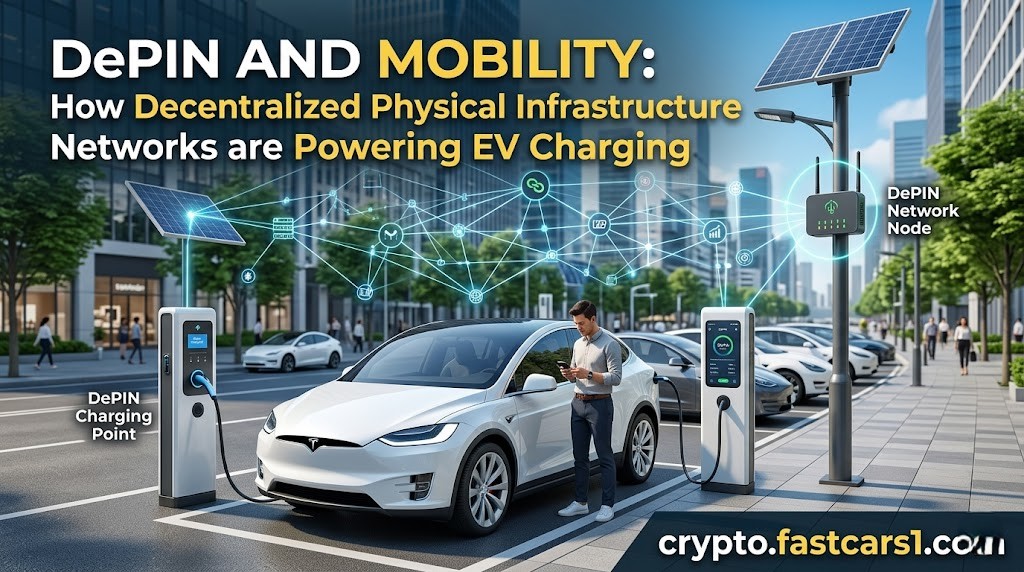
DePIN and Mobility: How Decentralized Physical Infrastructure Networks are Powering EV Charging.

The global transition to Electric Vehicles (EVs) faces a massive, physical bottleneck: the charging infrastructure. While automakers are producing EVs at record speeds, the rollout of charging stations often lags behind due to bureaucratic delays, high installation costs, and centralized grid limitations.
Enter DePIN (Decentralized Physical Infrastructure Networks). This revolutionary model is leveraging blockchain to incentivize individuals and small businesses to build and manage the world’s EV charging network. By shifting from a “top-down” to a “bottom-up” approach, DePIN is democratizing energy and accelerating the future of mobility.
1. What is DePIN? The “Uber” of Infrastructure
DePIN is a concept where a decentralized network of participants builds, maintains, and operates physical hardware in the real world. In exchange for providing this infrastructure—such as an EV charger, a 5G node, or a weather station—participants earn rewards in the form of cryptocurrency tokens.
In the context of mobility, DePIN allows a homeowner with a driveway or a shopkeeper with a parking lot to install a charger and become a mini-utility provider. They are no longer just “customers” of the grid; they are active infrastructure operators.
2. Solving the “Range Anxiety” through Crowdsourcing
The biggest fear for EV owners remains “range anxiety”—the fear of being stranded without a charger. Centralized providers like Tesla (Superchargers) or Ionity focus on highways and major cities, often leaving “charging deserts” in rural or residential areas.
DePIN platforms like Peaq, IoTeX, or Power Ledger solve this by:
-
Hyper-Local Coverage: Encouraging individuals in suburban areas to list their home chargers on a global, decentralized map.
-
Low Entry Barriers: Instead of waiting years for a city council to install a public charger, a DePIN network can add thousands of “community-owned” chargers in a matter of months.
3. The Tokenomic Incentive: How the Economy Works
The magic of DePIN lies in its incentive structure. Building a charging network is expensive, but blockchain lowers the capital expenditure (CapEx) for the central company:
-
The Installation: An individual buys and installs a compatible EV charger.
-
The Reward: Every time a driver uses that charger, the owner earns a fee in stablecoins (USDC) plus “Network Tokens” as a reward for contributing to the infrastructure.
-
The Value Loop: As the network grows, the token’s value often increases, further incentivizing more people to join and install chargers.
4. Peer-to-Peer (P2P) Energy Trading
DePIN isn’t just about the hardware; it’s about the energy. With blockchain-enabled smart meters, EV owners can participate in P2P energy trading.
If you have solar panels on your roof and your EV is fully charged, you can sell your excess energy directly to your neighbor’s EV through a DePIN charging station. The smart contract handles the transaction instantly, ensuring you get paid the market rate without a middleman utility company taking a massive cut.
5. Security and Interoperability
A major challenge with traditional charging networks is that you often need five different apps and five different accounts for five different brands of chargers.
DePIN uses Self-Sovereign Identity (SSI). Your EV has its own digital wallet and ID. When you pull up to a DePIN charger—regardless of who owns it—your car “negotiates” with the charger. They verify each other’s identity on the blockchain, the car charges, and the payment is settled automatically via a smart contract. No apps, no cards, no friction.
6. The 2026 Impact: Greening the Grid
As of 2026, DePIN projects are playing a crucial role in “Grid Balancing.” During peak hours, the network can incentivize EV owners to discharge a small amount of their battery back into the grid to prevent blackouts, rewarding them with tokens. This turns the global EV fleet into a massive, decentralized battery that stabilizes the entire planet’s energy supply.
Conclusion: The Infrastructure of the People
The era of waiting for giant corporations to build our world is ending. DePIN is proving that a motivated community, powered by blockchain incentives, can build a faster, cheaper, and more resilient EV charging network than any centralized entity.
For the EV owner, DePIN means more chargers and lower costs. For the participant, it means a new way to earn passive income while contributing to a greener planet. The future of mobility is not just electric—it is decentralized.
