
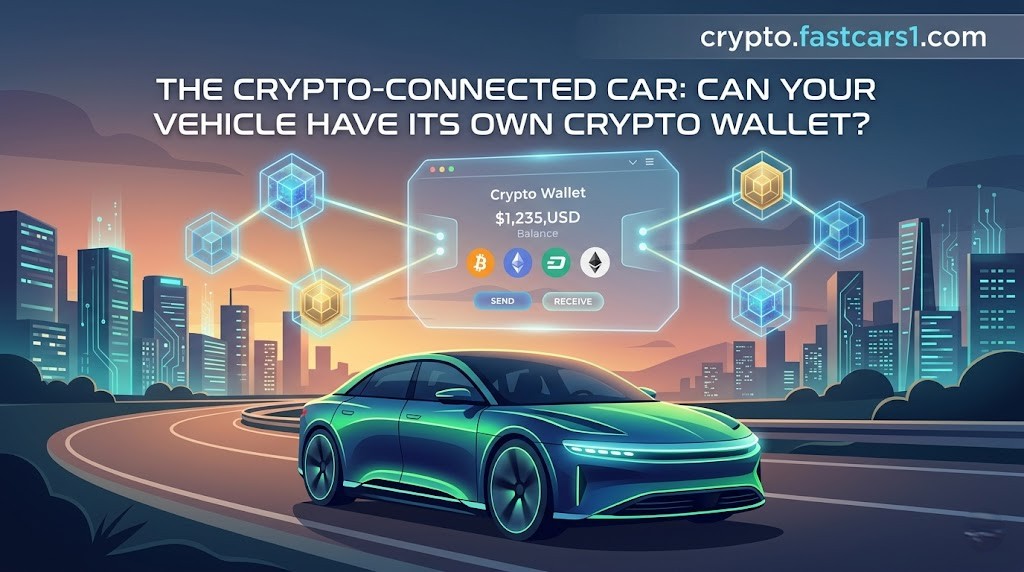
The Crypto-Connected Car: Can Your Vehicle Have Its Own Crypto Wallet?

In the traditional world of finance, a car is an “object” owned by a “person.” The car cannot make decisions, and it certainly cannot pay for its own expenses. However, as we move through 2026, the integration of Web3 and Automotive IoT is giving birth to a revolutionary concept: the Autonomous Economic Agent.
In simple terms, your car is getting its own crypto wallet. This isn’t just about you paying for gas with Bitcoin from your phone; it’s about the vehicle itself owning, managing, and spending digital assets. Here is how the “Crypto-Connected Car” is changing the road forever.
1. The Vehicle as an Independent Economic Entity
With a built-in crypto wallet, a car stops being a passive machine and becomes an active participant in the economy. This is made possible through Decentralized Identifiers (DIDs). Each car is assigned a unique, blockchain-based ID that is linked to a digital wallet embedded in the vehicle’s hardware security module (HSM).
This allows the car to sign transactions and hold balances in stablecoins (like USDC) or native network tokens. Your car can now “own” money, separate from your personal bank account.
2. Automated “Zero-Click” Payments
The most immediate benefit of a vehicle wallet is the elimination of manual payments. Imagine the convenience of a “Frictionless Road Trip”:
-
Smart Tolls: As you drive through a toll booth, your car’s wallet communicates with the toll’s smart contract and pays the fee instantly via a micro-transaction. No tags, no stopping, and no monthly bills.
-
Autonomous Charging: When an EV pulls into a charging station, the car and the charger “negotiate” the price. Once the plug is connected, the car pays for the exact amount of electricity it receives in real-time.
-
Parking Without Apps: Your car can pay for its own parking spot by the minute. When you drive away, the payment stops automatically.
3. The Car as a Revenue Generator
A car with a wallet doesn’t just spend money; it can also earn it. This is where the concept of the “Self-Sustaining Car” becomes reality.
-
Data Monetization: As discussed in previous articles, your car can sell its sensor data (traffic, weather, road quality) to mapping providers and deposit the earnings directly into its own wallet.
-
Energy Arbitrage: A crypto-connected EV can buy electricity when it’s cheap (at night) and sell it back to the grid when it’s expensive (during peak hours), keeping the profit to cover its own insurance or maintenance costs.
-
P2P Ride-Sharing: In the future, an autonomous car could pick up passengers while you sleep, collect the fare in crypto, and pay for its own cleaning and charging before returning home.
4. Machine-to-Machine (M2M) Communication
The true power of a vehicle wallet lies in Machine-to-Machine (M2M) transactions. On a crowded highway, cars could theoretically “negotiate” with each other.
-
The “Fast Lane” Protocol: If you are in a hurry, your car could send a micro-payment to the car in front of you to safely change lanes and let you pass.
-
Peer-to-Peer Charging: If you are low on battery, your car could “buy” a 10% charge from a nearby vehicle while parked at a mall, with the transaction settled instantly between the two vehicle wallets.
5. Security: Can Your Car Be Hacked?
Giving a car a wallet raises obvious security concerns. However, blockchain offers a higher level of security than traditional credit card systems.
-
Biometric Synchronization: Most systems in 2026 require the owner’s biometric approval (via a smartphone or fingerprint on the steering wheel) for transactions above a certain limit.
-
Hardware Wallets: The private keys are stored in a “Secure Element” within the car’s computer, which is isolated from the infotainment system, making it nearly impossible for remote hackers to steal the car’s funds.
6. The 2026 Reality: Brands Leading the Way
Automotive giants like BMW, Mercedes-Benz, and Jaguar Land Rover have already begun testing “Smart Wallets” in their luxury models. Simultaneously, blockchain ecosystems like IOTA and Peaq are building the specialized infrastructure needed to handle millions of vehicle transactions per second with zero fees.
Conclusion: A New Member of the Economy
The crypto-connected car represents a fundamental shift in our relationship with technology. We are moving from a world where we “use” machines to a world where we “collaborate” with them. By giving your vehicle its own crypto wallet, you are turning a depreciating asset into an intelligent, economic partner.
The next time you start your engine, remember: your car might just be more financially savvy than you think.
