
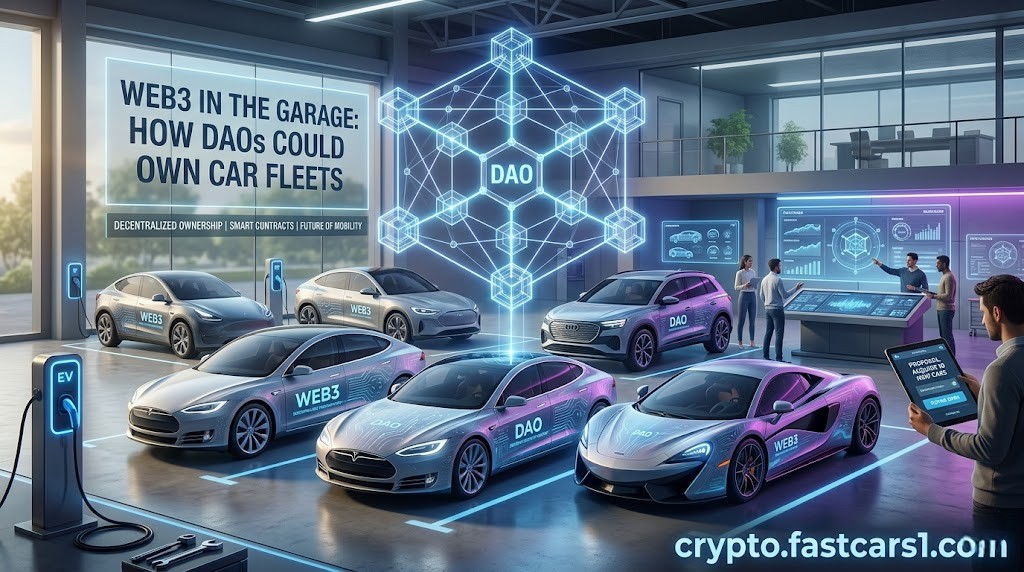
Web3 in the Garage: How Decentralized Autonomous Organizations (DAOs) Could Own Car Fleets.

For decades, the concept of a “car fleet” was synonymous with giant corporations—rental agencies like Hertz, logistics giants like FedEx, or corporate taxi companies. Ownership was centralized, and the profits were held by a few board members. However, the rise of Web3 and Decentralized Autonomous Organizations (DAOs) is about to shatter this model.
Imagine a fleet of autonomous electric vehicles (EVs) that isn’t owned by a company, but by a global community of thousands of individuals. This isn’t a dream; it’s a structural shift in how we manage mobility assets. Here is how DAOs are moving into the garage and turning “passengers” into “owners.“
1. What is an Automotive DAO?
A DAO is an organization represented by rules encoded as a computer program that is transparent, controlled by the organization members, and not influenced by a central government.
In the automotive world, a Mobility DAO is a community that pools funds (via cryptocurrency) to purchase a fleet of vehicles. The “rules” of the fleet—how much to charge for a ride, when to upgrade the cars, and how to distribute profits—are governed by Smart Contracts and voted on by token holders. There is no CEO; the code and the community are the boss.
2. Fractional Ownership: A Fleet for Everyone
Traditionally, owning a fleet required millions of dollars in capital. A DAO lowers the barrier to entry to just a few dollars.
-
Tokenization of Assets: A fleet of 100 Tesla Robotaxis can be represented by 1,000,000 governance tokens.
-
Global Participation: A student in Cairo, a developer in Berlin, and a farmer in Brazil can all own a “fraction” of the same fleet. They contribute to the initial purchase and, in return, receive a share of the revenue generated by the fleet’s daily operations.
3. Automated Management: The “Zero-Employee” Company
The power of a DAO lies in its efficiency. Because the vehicles are connected to the blockchain (as discussed in our vehicle-wallet article), the entire business cycle can be automated:
-
The Ride: A passenger books a ride through a decentralized app (dApp).
-
The Payment: The fare is paid in stablecoins directly to the DAO’s smart contract.
-
The Overhead: The car autonomously pays for its own charging and maintenance using its internal wallet.
-
The Profit: The remaining profit is automatically distributed to the DAO token holders’ wallets.
No human managers, no payroll departments, and no corporate office—just a fleet of machines working for a community of owners.
4. Collective Governance: Voting on the Future
Being a member of a Mobility DAO isn’t just about passive income; it’s about active decision-making. Token holders can vote on “Proposals”:
-
“Should we sell our older Model 3s and upgrade to the new Cybercab?”
-
“Should we lower our ride-sharing rates in Tokyo to gain more market share?”
-
“Should we allocate 5% of profits to plant trees to offset our fleet’s carbon footprint?”
This creates a “Democratic Mobility” system where the users and owners are the same people, ensuring the service evolves according to the community’s needs.
5. Solving the “Trust” Problem in Peer-to-Peer Mobility
The biggest hurdle for decentralized ride-sharing has always been trust. How do you trust a fleet that has no central headquarters? Blockchain solves this through Transparency. Every ride, every repair, and every cent earned is recorded on a public ledger. You don’t need to trust a “Company”; you only need to trust the “Immutable Code.” If the smart contract says you get 0.01% of every fare, you will get it—automatically and instantly.
6. The Challenges: Liability and Regulation
The “Fleet DAO” model faces significant legal hurdles in 2026. Who is responsible if a DAO-owned car is involved in an accident? How do you tax an organization that has no physical office? To solve this, “Legal Wrappers” (like the DAO laws in Wyoming or the Marshall Islands) are being used to give these digital entities legal standing. We are seeing a transition toward Hybrid DAOs, where a legal entity handles the physical world (insurance, registration) while the blockchain handles the logic and finances.
Conclusion: The Democratization of the Road
The era of centralized transportation monopolies is facing its greatest challenge. By combining autonomous EVs with the governance of a DAO, we are creating a mobility system that is more efficient, more transparent, and more inclusive.
In the future, you won’t just “call an Uber”; you will use a service that you—and thousands of others—actually own. The garage of the future is decentralized, and the keys are held by the community.
