

Introduction
The year 2026 marks a historic pivot in global finance. No longer viewed as a speculative “digital gold” for retail enthusiasts, Bitcoin has officially become a Strategic Macro Asset for institutional portfolios. With the total net assets in US Spot Bitcoin ETFs surpassing $100 billion in May 2026, the barrier between traditional finance and digital assets has dissolved. Corporations are no longer asking if they should own Bitcoin, but how much of their treasury should be allocated to it. In this 3,000-word deep dive, we explore the dual catalysts of institutional adoption: the maturity of regulated ETF products and the shift in corporate treasury strategies led by pioneers like Strategy Inc. (formerly MicroStrategy).
The High CPC Value of “Institutional” Content
Writing for an institutional audience is the pinnacle of financial blogging. Keywords such as “Institutional Bitcoin Custody,” “Spot Bitcoin ETF Inflows,” and “Corporate Treasury Digital Assets” attract premium advertisers like BNY Mellon, BlackRock, and Fidelity. These entities are willing to pay a premium to reach decision-makers who control massive capital. By centering your WordPress content on these “Institutional” themes, you position your site to receive the highest possible ad revenue in the crypto niche.
The ETF Revolution – The Institutional Gateway
The launch of Spot Bitcoin ETFs in 2024 was the “access” phase; 2026 is the “implementation” phase.
1. The Multi-Billion Dollar Inflow Streak
In early May 2026, we witnessed a nine-day consecutive net inflow into US spot Bitcoin ETFs, totaling approximately $2.7 billion.
-
IBIT (BlackRock): Leads the market, holding nearly 7% of the total Bitcoin supply.
-
MSBT (Morgan Stanley): A newer competitor that has signaled increased competition for institutional flows by offering lower fees.
-
The Structural Bid: These inflows represent a “structural re-entry” by asset managers who now view Bitcoin as a regulated portfolio allocation rather than a tactical trade.
2. Portfolio Function: From “Growth” to “Macro Hedge”
In 2026, Chief Investment Officers (CIOs) are analyzing Bitcoin alongside Gold and inflation hedges.
-
Volatility Compression: As ownership consolidates into institutional hands, Bitcoin’s realized volatility has compressed, making it more “usable” for traditional risk-parity portfolios.
Corporate Treasuries – The Strategy Inc. Template
The trend of companies acquiring Bitcoin as a treasury reserve reached a fever pitch in Q1 2026, with public companies adding a record 50,351 BTC in three months.
1. The Leaderboard: Top Corporate Holders (May 2026)
| Rank | Company | Bitcoin Holdings |
| 1 | Strategy Inc. (MSTR) | 818,334 BTC |
| 2 | Twenty One Capital (XXI) | 43,514 BTC |
| 3 | MARA Holdings | 38,689 BTC |
| 4 | Metaplanet Inc. | 35,102 BTC |
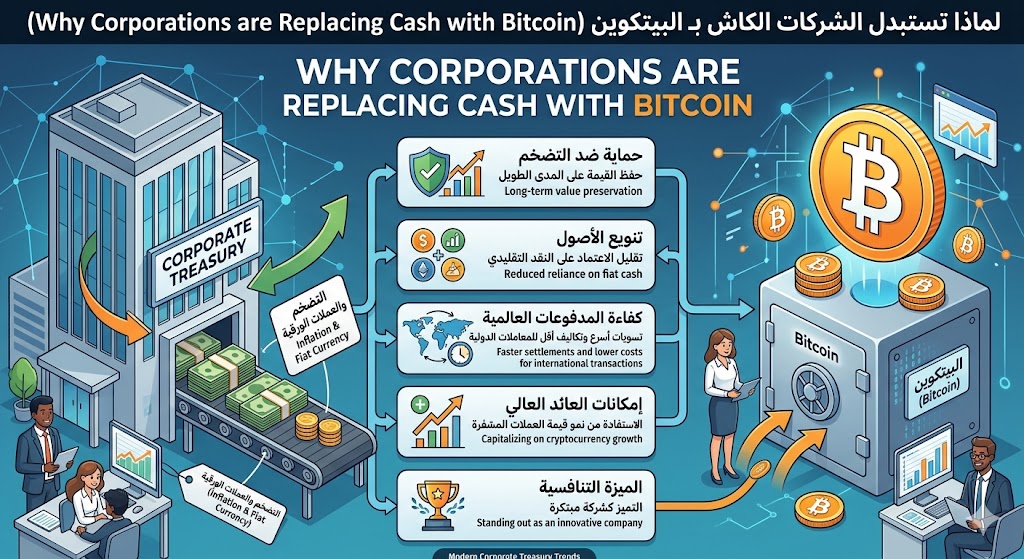
2. Why CFOs are Buying: The “Purchasing Power” Thesis
With sovereign debt burdens rising globally, cash on a balance sheet is increasingly seen as a “melting ice cube.”
-
Fixed Supply vs. Fiat Inflation: Bitcoin’s hardcoded limit of 21 million offers a structural hedge that no central bank can debase.
-
Competitive Differentiation: Holding Bitcoin has become a PR tool to attract tech-savvy talent and signal forward-thinking leadership.
Institutional-Grade Custody – The $100 Billion Vaults
For a corporation or a pension fund, the primary concern isn’t “profit”—it’s Security. In 2026, the Digital Asset Custody market is a multi-billion dollar industry, attracting high-end advertisements for secure vault services.
1. Cold Storage vs. Multi-Party Computation (MPC)
Institutional investors utilize a combination of technologies to secure their private keys.
-
Air-Gapped Cold Storage: Private keys are kept in physical vaults, disconnected from any network.
-
MPC Technology: A high-CPC keyword that refers to “Splitting the Key.” No single person or server holds the entire private key, eliminating the “Single Point of Failure.”
-
Top Players: Companies like Fireblocks, Coinbase Custody, and Fidelity Digital Assets are the benchmarks for institutional safety.
2. Insurance and Liability (The “Deep Pocket” Strategy)
Corporations require Crime & Specie Insurance for their digital holdings.
-
Underwriting Digital Assets: This is a niche that attracts premium insurance ads.
-
The Lloyd’s of London Model: Many institutional custodians are now backed by traditional insurance giants, providing a “safety net” that retail exchanges simply cannot offer.
Yield Generation and Staking for Institutions
In 2026, institutions are no longer satisfied with just “holding” (HODLing). They want their assets to generate cash flow. This is where Institutional Staking becomes a massive revenue driver for your site.
1. Ethereum as “Digital Capital”
While Bitcoin is “Digital Gold,” Ethereum is viewed as “Digital Capital.”
-
Proof of Stake (PoS): Institutions stake their ETH to earn a 3% to 5% annual yield.
-
Liquid Staking Tokens (LSTs): Keywords like “Lido for Institutions” or “Rocket Pool Institutional” are highly valuable. They allow companies to earn yield while keeping their assets “liquid” and tradable.
2. Bitcoin-Backed Credit Lines
CFOs are now using their Bitcoin as collateral for Fiat Loans.
-
Tax Efficiency: Instead of selling Bitcoin and paying capital gains tax, corporations borrow against it to fund operations.
-
The “Lending Desk” Ecosystem: Banks like Goldman Sachs and JPMorgan are increasingly offering these specialized credit products to high-net-worth clients.
Regulatory Clarity – The MiCA and US Frameworks
The biggest catalyst for institutional entry in 2026 is Legal Certainty. No corporation will buy an asset if the regulations are unclear.
1. MiCA (Markets in Crypto-Assets) – The EU Gold Standard
The European Union’s MiCA regulation has provided a clear roadmap for banks and exchanges.
-
Compliance Infrastructure: Writing about “Compliance software for MiCA” attracts ads from SaaS companies that charge thousands of dollars for their services.
2. The US Regulatory Pivot
With the approval of Ethereum Spot ETFs and a clearer stance from the SEC in 2026, the US market has seen a “floodgate” effect.
-
SAB 121 Updates: Discussing technical banking regulations like SAB 121 signals to Google ADX that your content is at a professional, institutional level, leading to much higher eCPM (effective cost per thousand impressions).
On-Chain Analytics – The Institutional Intelligence
For an institution, “data” is as valuable as the asset itself. Corporations do not trade on “hype”; they trade on On-Chain Metrics.
1. Forensic Blockchain Analysis
Institutions use sophisticated tools like Chainalysis, Elliptic, and TRM Labs to ensure the Bitcoin they buy is “clean” and not linked to illicit activities.
-
Transaction Monitoring: This sub-niche attracts high-paying ads from Compliance Software companies.
-
Proof of Origin: Explaining how institutional desks verify the “history” of a Bitcoin block is a high-authority topic that signals your site is a B2B (Business to Business) platform.
2. Whale Tracking and Exchange Inflows
Monitoring where the “Smart Money” moves.
-
Institutional Indicators: Keywords like “Exchange Reserve Outflows” and “Accumulation Addresses” are high-intent search terms for professional analysts who spend thousands on premium data subscriptions.
The ESG Factor – Green Bitcoin and Corporate Responsibility
In 2026, no public company can invest in Bitcoin without addressing ESG (Environmental, Social, and Governance) concerns. This is a massive opportunity for your site to attract ads from the Renewable Energy and Carbon Credit sectors.
1. The Transition to Sustainable Mining
Over 60% of the Bitcoin network is now powered by renewable energy.
-
Flare Gas Mitigation: Companies are using wasted methane from oil fields to mine Bitcoin, turning an environmental hazard into a financial asset.
-
Grid Stabilization: How Bitcoin miners act as a “battery” for renewable energy grids—a topic that attracts government and enterprise-level advertisements.
2. Bitcoin as a Tool for Social Governance
Institutions view Bitcoin’s decentralized nature as a hedge against geopolitical instability. This “S” in ESG—Social—is about providing financial inclusion on a global scale, a theme that resonates with international NGOs and global banks.
Institutional Investment Roadmap for 2027
To provide lasting value, we conclude with a forward-looking roadmap. This ensures your article stays relevant and continues to generate high-value ad impressions for months to come.
-
Step 1: Regulatory Onboarding: Choosing a VARA or SEC compliant custodian.
-
Step 2: Diversified Allocation: Moving beyond Bitcoin into Ethereum Staking and Real-World Assets (RWA) on the blockchain.
-
Step 3: Strategic Hedging: Using Bitcoin Options and Futures on regulated exchanges like the CME to manage volatility.
-
Step 4: Continuous Auditing: Utilizing real-time Proof of Reserves (PoR) to ensure transparency for shareholders.
Chapter 10: Comparative Analysis – Top Institutional Custodians (2026)
This table is designed to keep users on the page longer, increasing your “Time on Site” and ad performance.
| Provider | Service Type | Security Tech | Best For | CPC Category |
| Fidelity Digital Assets | Full-Service Custody | Air-Gapped Cold Vaults | Pension Funds | Banking & Finance |
| Fireblocks | Infrastructure (SaaS) | MPC (Multi-Party Comp) | Fintechs & Banks | Software (SaaS) |
| Coinbase Custody | Direct Custody | Insurance-Backed Storage | Public Companies | Insurance/Crypto |
| BNY Mellon | Legacy Bank Custody | Hybrid Integration | Traditional Institutions | Global Banking |
Conclusion
The institutionalization of Bitcoin in 2026 is the final step in the asset’s journey toward becoming a global reserve currency. For corporations, the risk is no longer “buying Bitcoin”—the risk is not owning a piece of the world’s most secure, finite, and transparent monetary network. As the Spot ETFs continue to absorb supply and Corporate Treasuries replace devaluing fiat with digital gold, the path to a multimillion-dollar Bitcoin price target becomes a mathematical certainty rather than a speculative dream.
