
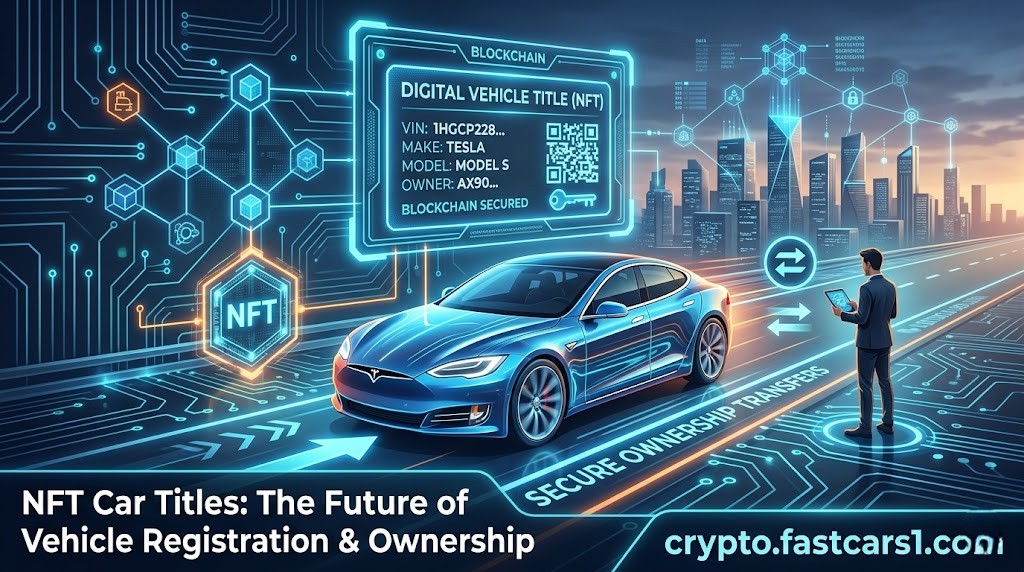

NFT Car Titles: The Future of Vehicle Registration and Ownership Transfers
For over a century, the concept of car ownership has been tethered to a physical piece of paper: the vehicle title. Whether it’s called a “Pink Slip” in the U.S. or a “Logbook” in the UK, this document is the ultimate proof of ownership. However, paper is fragile, easy to forge, and painfully slow to transfer.
As we advance into 2026, the automotive industry and government transit authorities are moving toward a more secure, digital-first solution: NFT Car Titles. By representing vehicle ownership as a Non-Fungible Token on a blockchain, we are entering an era of “One-Click” ownership transfers and unhackable registration.
1. Beyond Digital Art: The Utility of NFTs
While the public often associates NFTs with digital art or collectibles, their true power lies in unique digital identity. An NFT is, by definition, a one-of-a-kind digital certificate that cannot be copied or split.
In the context of vehicle registration, an NFT acts as a “Digital Deed.” It contains the car’s VIN, its full legal history, and its current owner’s digital signature. Unlike a PDF or a scan of a paper title, an NFT title is live, verifiable on a public or private ledger, and cryptographically secure.
2. The End of DMV Waiting Rooms: Instant Ownership Transfers
Anyone who has bought or sold a car knows the bureaucratic headache of transferring a title. It often involves physical visits to government offices, notary signatures, and days or weeks of waiting for the new paper title to arrive in the mail.
With NFT titles, the transfer of ownership is as simple as sending a digital message:
-
The Transaction: Once the buyer sends the payment (via a smart contract), the NFT title is automatically transferred from the seller’s digital wallet to the buyer’s.
-
Instant Update: The government’s central registry (which acts as a node on the blockchain) is updated in real-time. No paperwork, no mailing, and no manual data entry.
-
Security: Because the transfer requires the seller’s private key, it is virtually impossible for a criminal to “steal” a car title through traditional identity theft.
3. Eliminating Title Fraud and “Title Washing”
“Title washing” is a common scam where sellers hide a car’s “Salvage” or “Totaled” status by moving the car to a state with different registration rules and getting a “clean” paper title.
Because a blockchain ledger is global and immutable, an NFT title is impossible to “wash.” If a car is marked as “Salvage” in one jurisdiction, that status is permanently etched into the NFT’s metadata. No matter where the car is moved, the digital title will tell the truth about its history, protecting buyers from expensive and dangerous mistakes.
4. Integration with Smart Licenses and Digital IDs
In 2026, many countries are adopting Digital IDs and Mobile Driver’s Licenses (mDL). NFT car titles integrate perfectly with these systems. Your digital wallet could hold:
-
Your Digital Driver’s License.
-
Your Car’s NFT Title.
-
Your Digital Insurance Card.
If a police officer stops a vehicle, they don’t need to check physical papers. A quick scan of a QR code can verify the car’s registration and its owner’s license status in seconds, ensuring that everything is legitimate and up to date.
5. Fractional Ownership and the “Share Economy”
The move to NFT titles also opens the door to new economic models, such as Fractional Ownership. Imagine a rare, multi-million dollar classic Ferrari. Instead of one person owning it, ten investors could own a percentage of the car, represented by “fractionalized” tokens linked to the main NFT title.
This technology makes high-value car investments accessible to more people and simplifies the process of managing shared vehicles or corporate fleets.
6. The Roadmap to Global Adoption
The transition to NFT titles is already underway. Several U.S. states and countries in the Middle East and Europe have launched pilot programs to move their DMV (Department of Motor Vehicles) records to the blockchain.
The main challenge is not the technology, but the Legacy Infrastructure. Governments must update their legal frameworks to recognize a “digital token” as a legal proof of ownership. However, the cost savings—estimated in the billions for taxpayers and agencies—are making the switch inevitable.
Conclusion: A Seamless Future for Car Owners
The death of the paper title is a major milestone in the digitalization of our lives. NFT car titles offer a level of security, transparency, and speed that traditional systems simply cannot match. In the near future, the stress of losing a “Pink Slip” will be a thing of the past. Your car’s identity will be as secure as your bank account, and selling a vehicle will be as easy as sending an email.
