
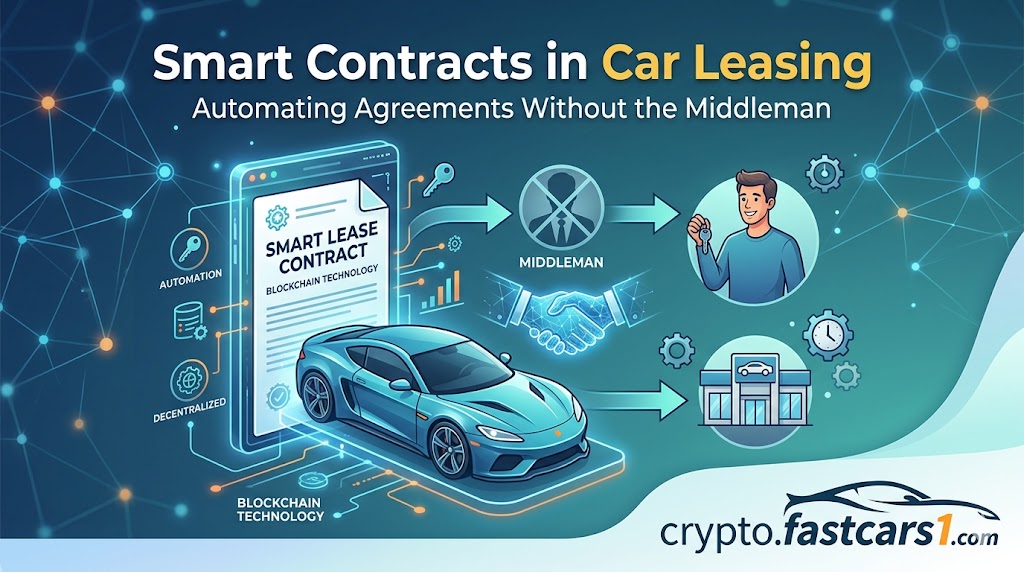
Smart Contracts in Car Leasing: Automating Agreements Without the Middleman.

Smart Contracts in Car Leasing: Automating Agreements Without the Middleman
The traditional car leasing process is often a slow, paper-heavy marathon. From credit checks and insurance verification to the final signature at a dealership, the “middlemen”—banks, brokers, and legal departments—add layers of complexity and cost. However, a new paradigm is shifting gears. Smart Contracts, powered by blockchain technology, are turning car leasing into a “code-driven” experience, allowing for automated, trustless agreements that benefit both the lessor and the lessee.
In this article, we explore how smart contracts are removing the friction from vehicle leasing and why the “middleman” might soon become obsolete.
1. What is a Smart Contract in a Leasing Context?
A smart contract is a self-executing agreement where the terms of the lease are written directly into lines of code. Unlike a traditional paper contract, a smart contract doesn’t just “state” the rules—it enforces them automatically.
For example, a lease agreement can be programmed to release the digital key of a vehicle only after the initial security deposit is confirmed on the blockchain. No human intervention, no waiting for bank clearance, and no manual paperwork.
2. Automating Payments and Reducing Defaults
One of the biggest headaches for leasing companies is late payments and the costly process of repossessing vehicles. Smart contracts introduce a level of automation that simplifies this for everyone:
-
Automatic Withdrawals: Lease payments can be automated via stablecoins (USDC/USDT). If the funds aren’t available, the contract can trigger an immediate notification.
-
Smart Repossession: In a blockchain-integrated vehicle, the smart contract can be linked to the car’s software. If a payment is missed by a specific grace period (e.g., 15 days), the contract can “lock” the digital ignition, preventing the car from starting until the debt is settled. While this sounds futuristic, several pilot programs in 2026 are already testing these “programmable lockdowns” to reduce the risk of defaults.
3. Real-Time Insurance and Compliance
Traditionally, a lessee must prove they have active insurance before driving away. With smart contracts, this process is instantaneous.
The lease contract can “talk” to the insurance company’s blockchain. If your insurance expires, the smart contract is notified immediately. It can then automatically adjust the lease rate or send an alert to the leasing company. This creates a “Live Compliance” environment where all parties are protected 24/7 without needing a clerk to check physical documents.
4. Maintenance and Usage-Based Leasing
Not all car leases should be the same. A person who drives 500 miles a month shouldn’t necessarily pay the same as someone who drives 3,000.
Through IoT (Internet of Things) sensors, a smart contract can track the vehicle’s mileage and wear-and-tear in real-time.
-
Dynamic Pricing: The contract can automatically calculate the monthly payment based on the actual usage.
-
Automated Service Alerts: When the blockchain logs that the car has hit its 10,000-mile mark, the smart contract can automatically book a service appointment at a verified center and deduct the maintenance fee from a pre-funded wallet.
5. Removing the Broker: Lowering Costs for Consumers
Every middleman in a lease agreement takes a cut. Brokers, credit agencies, and notary services all add to the “Document Fee” you see at the bottom of your invoice.
By using a decentralized ledger, the lessee’s credit history and identity (Decentralized Identity or DID) can be verified instantly without an expensive third-party agency. This “Direct-to-Consumer” leasing model can reduce the total cost of a lease by 10% to 15%, making luxury vehicles more accessible to a wider audience.
6. The 2026 Outlook: Legal Challenges and Adoption
Despite the efficiency, there are still hurdles. The legal status of “Code as Law” varies by country. In 2026, we are seeing “Hybrid Contracts” where a traditional legal document refers to a blockchain smart contract for its execution. As courts become more familiar with digital ledger technology, we expect to see fully autonomous leasing platforms where you can browse, sign, and “unlock” a car in under five minutes—entirely from your smartphone.
Conclusion: The Future of Frictionless Mobility
Smart contracts are bringing the “Amazon experience” to car leasing. By automating the boring, expensive, and slow parts of the agreement, blockchain technology is allowing for more flexible, cheaper, and safer leases. The era of waiting in a dealership office for three hours to sign a mountain of paper is coming to an end. The future of leasing is digital, automated, and middleman-free.
