
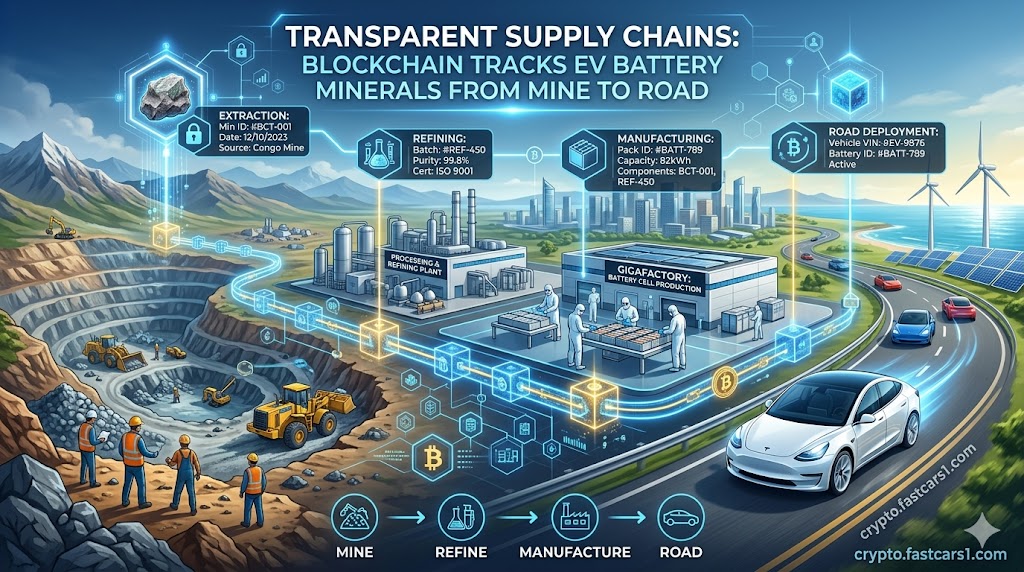
Transparent Supply Chains: How Blockchain Tracks EV Battery Minerals from Mine to Road

The global shift toward Electric Vehicles (EVs) is driven by the promise of a cleaner, greener future. However, beneath the sleek hoods of these modern machines lies a complex and often controversial supply chain. The minerals required for EV batteries—specifically lithium, cobalt, nickel, and graphite—are often sourced from regions plagued by environmental degradation and human rights concerns.
As we move through 2026, the automotive industry is facing a dual challenge: skyrocketing demand for batteries and a fierce regulatory crackdown on unethical sourcing. The solution? Blockchain-backed transparency. By creating an immutable digital trail, automakers are now able to track battery minerals from the dark depths of a mine to the open road.
1. The “Blood Cobalt” Crisis and the Need for Change
For years, the EV industry was haunted by reports of child labor and hazardous working conditions in the Democratic Republic of Congo (DRC), which produces over 70% of the world’s cobalt. Traditional supply chains were “opaque,” meaning once the raw ore was sent to a smelter and mixed with other batches, its origin became impossible to verify.
Blockchain changes this dynamic. By assigning a Digital Twin to each batch of raw ore at the mine site, every hand that touches the material—the refiner, the cell manufacturer, and the final assembly plant—must cryptographically sign for its “Chain of Custody.“
2. The 2026 “Battery Passport” Mandate
One of the biggest catalysts for this technology is the EU Battery Passport regulation, which officially entered its critical compliance phase in 2026. This mandate requires all new EV batteries sold in Europe to carry a digital record (accessible via a QR code) that details:
-
Carbon Footprint: Exactly how much CO2 was emitted during the mining and manufacturing process.
-
Recycled Content: The percentage of materials recovered from old batteries.
-
Ethical Sourcing: Proof that the minerals were obtained in compliance with international labor standards.
Blockchain is the only technology capable of securing this data across multiple borders and dozens of different suppliers without the risk of data manipulation.
3. Real-Time Tracking: From Ore to Cathode
The journey of a blockchain-tracked mineral follows a rigorous process:
-
The Source: At the mine, bags of ore are tagged with NFC (Near-Field Communication) chips or unique chemical “fingerprints.“
-
The Ledger: As the ore is refined into battery-grade chemicals, a smart contract updates the digital ledger. If a refiner tries to mix “clean” cobalt with “unverified” cobalt, the blockchain detects the mass imbalance and flags the batch.
-
The Assembly: When the battery cells are built, the blockchain records the precise “chemical recipe” and origin of each component.
-
The Road: When you buy your EV, you receive a certificate of authenticity, proving your car’s battery didn’t contribute to environmental or social harm.
4. Automakers Leading the Charge
Leading manufacturers like Volvo, BMW, and Tesla have already integrated blockchain platforms (such as Circulor or RCS Global) into their logistics. For these brands, blockchain is more than a compliance tool—يت’s a marketing advantage. In an era where consumers are increasingly “eco-conscious,” being able to prove that your vehicle is 100% ethically sourced is a powerful selling point.
5. Improving Battery Recyclability and Second Life
The “Mine to Road” journey doesn’t end when the car is sold. Blockchain also tracks the State of Health (SoH) of the battery throughout its life. When an EV is retired, the blockchain data tells recyclers exactly what minerals are inside and in what concentration. This makes the recycling process more efficient, allowing for a “Closed Loop” where the minerals from your old car are used to build a brand-new battery, reducing the need for new mining altogether.
6. The Economic Impact: Reducing “Greenwashing”
“Greenwashing”—the practice of making false or misleading claims about the environmental benefits of a product—is becoming harder to get away with. With a blockchain-powered supply chain, claims of “Zero Carbon” or “Ethically Sourced” are no longer just PR statements; they are mathematical certainties that can be audited by any regulator or consumer.
Conclusion: Trust is the New Fuel
The EV revolution is only as sustainable as its supply chain. By leveraging blockchain technology to track minerals from the mine to the road, the automotive industry is finally aligning its environmental goals with its ethical responsibilities.
For the buyer of 2026, the peace of mind that comes with a “Digital Battery Passport” is just as important as the range or the horsepower of the vehicle. Trust, it seems, has become the most vital component in the modern electric car.
