
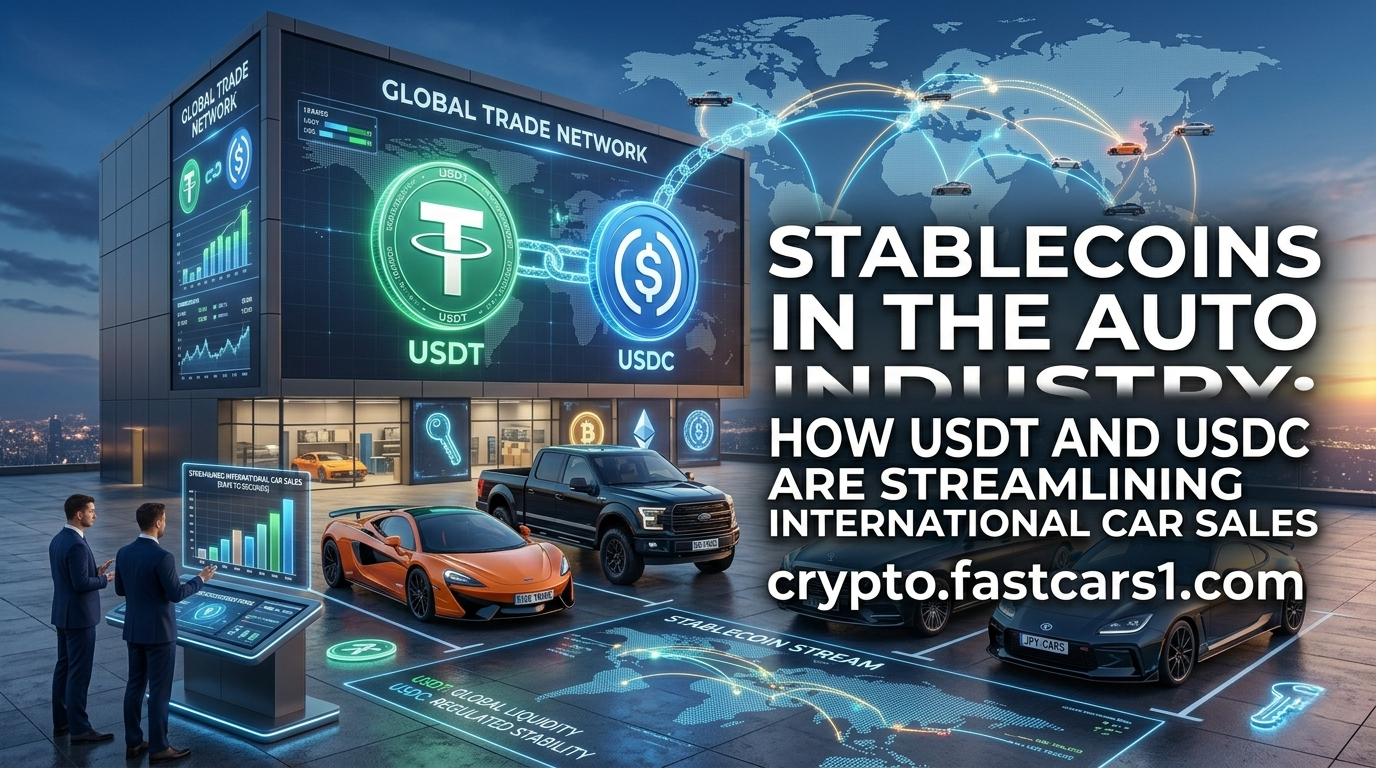
Stablecoins in the Auto Industry: How USDT and USDC are Streamlining International Car Sales.

In the volatile theater of digital assets, Bitcoin often takes the spotlight for its “moon” potential. However, in the pragmatic world of international trade—specifically the luxury automotive industry—a different class of tokens is quietly doing the heavy lifting. Stablecoins, such as Tether (USDT) and USD Coin (USDC), have emerged as the “bridge currency” of choice for global car exports and high-end dealership transactions.
While Bitcoin is treated as digital gold, stablecoins are functioning as digital cash. Here is an in-depth look at how these pegged assets are streamlining international car sales and solving age-old friction in the automotive supply chain.
1. Eliminating the “Volatility Tax”
The biggest hurdle for a car dealership in accepting crypto has always been price swings. If a dealer sells a Porsche for 2 BTC at 10:00 AM, that same 2 BTC could be worth 5% less by the time they pay their manufacturer at 2:00 PM.
Stablecoins solve this instantly. Because USDT and USDC are pegged 1:1 to the US Dollar, they provide the speed of blockchain with the stability of fiat. For an international buyer, this means they can lock in a price for a vehicle without worrying that a sudden market dip will leave them short on the final invoice.
2. Global Logistics and the Speed of Settlement
International car sales often involve three or four different jurisdictions: the manufacturer, the exporting dealer, the shipping company, and the end-buyer. Traditional SWIFT transfers are notoriously slow, taking anywhere from 3 to 7 business days to clear, especially when large sums move between continents like Europe, the Middle East, and Asia.
The 24/7 Liquidity Advantage
Unlike banks, the blockchain never closes. A dealership in Dubai can receive a payment in USDC from a buyer in Japan on a Sunday afternoon, confirm the transaction in minutes, and initiate the shipping process immediately. By cutting out “banking days” and “wire cut-off times,” stablecoins are effectively accelerating the global automotive supply chain by several days per transaction.
3. Reducing Foreign Exchange (FX) Friction
When a buyer in Europe wants to purchase a muscle car from a dealer in the United States, they typically have to convert Euros to Dollars. Banks often hide significant profit margins in these FX rates, sometimes charging 1% to 3% above the mid-market price.
By using USDT or USDC, both parties can operate in a dollar-denominated environment without needing a US bank account. For high-volume exporters, avoiding these “hidden” conversion fees can save tens of thousands of dollars annually, which can then be passed on to the consumer or reinvested into inventory.
4. Transparency and “Programmable” Escrow
One of the most exciting developments in the rise of stablecoins is the use of Smart Contracts. In a traditional international sale, there is a trust gap: the buyer doesn’t want to send money before the car is shipped, and the dealer doesn’t want to ship before receiving money.
Using stablecoins, a smart contract can act as a digital escrow. The funds (USDC) are “locked” in the contract. Once the shipping company uploads the Bill of Lading (the document proving the car is on the ship), the funds are automatically released to the dealer. This level of mathematical trust reduces the need for expensive third-party legal intermediaries.
5. Compliance and the “Institutional Grade” of USDC
While USDT (Tether) remains the king of liquidity, USDC has gained massive traction in the auto industry due to its reputation for transparency and regulatory compliance. Many high-end dealerships prefer USDC because it is issued by Circle, a US-regulated entity that undergoes regular audits.
For compliance departments at brands like Rolls-Royce or Mercedes-Benz, accepting a payment in a regulated stablecoin is much easier to justify to their auditors than accepting a volatile or “privacy-focused” cryptocurrency. It provides a clear, auditable trail that fits neatly into existing corporate accounting software.
6. Case Study: The Middle East Luxury Hub
Dubai has become the “ground zero” for stablecoin automotive transactions. Dealerships in the UAE frequently handle transactions for “hypercars” (cars costing over $1 million) using USDT. Because the UAE Dirham is pegged to the US Dollar, using a dollar-pegged stablecoin creates a perfect financial loop with zero exchange risk. This has made the region a magnet for international collectors who want to move capital quickly and securely.
The Road Ahead: Will Stablecoins Replace Wires?
As we move further into 2026, the question is no longer if stablecoins will be used in car sales, but how fast they will become the primary method. While traditional banks are still catching up with the speed of the digital economy, stablecoins like USDT and USDC are already providing a “fast lane” for global commerce.
For the international car buyer, the benefits are clear: lower fees, faster delivery, and total price certainty. For the industry, it’s a monumental shift toward a more efficient, borderless future.
