
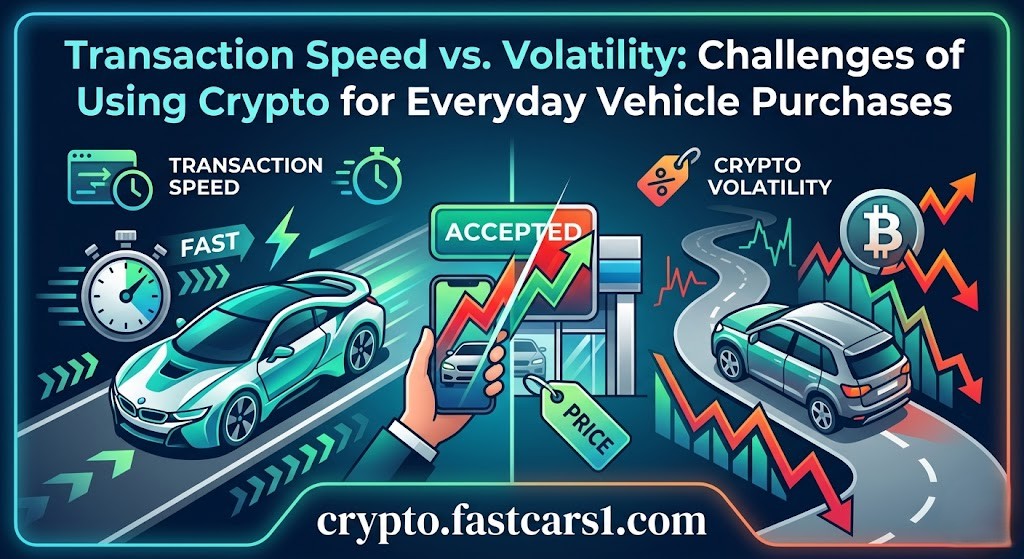
Transaction Speed vs. Volatility: Challenges of Using Crypto for Everyday Vehicle Purchases.

As digital assets transition from speculative investments to functional currencies, the dream of buying an everyday vehicle—be it a family SUV or a commuter sedan—using cryptocurrency is becoming a reality. However, for the average car buyer, two major technical hurdles remain parked in the middle of the road: Transaction Speed and Price Volatility.
While high-value “whale” transactions for limited-edition hypercars can afford to wait for blockchain confirmations, everyday retail purchases require a different level of efficiency. In this article, we explore the friction between the clock and the ticker, and how the industry is racing to solve it.
1. The Confirmation Lag: Why You Can’t Just “Tap and Go” (Yet)
Traditional payment systems like Visa or Mastercard process thousands of transactions per second (TPS). In contrast, the base layer of the Bitcoin blockchain processes about 7 TPS, with a block time of 10 minutes.
The Showroom Dilemma
Imagine standing in a dealership, ready to drive away in a new Ford or Toyota. If you pay via the Bitcoin mainnet, you might have to wait 30 to 60 minutes for the standard “six confirmations” to ensure the transaction is irreversible. For a high-paced retail environment, this lag is a significant barrier. No dealer wants a customer hovering in the lobby for an hour waiting for a digital ledger to update.
2. Volatility: The $5,000 Gear Shift
The most notorious challenge of crypto is its price instability. For a vehicle priced at $30,000, a sudden 5% market dip during the paperwork process could mean a $1,500 difference in value.
-
For the Buyer: There is a fear of “overpaying” if the price of Bitcoin spikes immediately after the transfer.
-
For the Dealer: There is the risk of a “liquidity crunch” if the asset devalues before they can convert it to fiat to pay their suppliers and staff.
This “volatility tax” makes traditional car dealerships hesitant to hold “naked” crypto assets on their balance sheets, leading to a reliance on instant-conversion payment gateways.
3. The Scalability Solution: Lightning Network and Layer 2
To combat the speed issue, the industry is moving toward “off-chain” solutions.
The Lightning Network
For Bitcoin, the Lightning Network acts as a second layer that allows for near-instant, low-fee transactions. In 2026, we are seeing more POS (Point of Sale) systems integrated with Lightning, allowing a car buyer to pay for a vehicle or a down payment as quickly as a credit card swipe.
Ethereum Layer 2s (L2)
Networks like Arbitrum, Optimism, and Polygon have drastically reduced the “gas fees” and confirmation times for Ethereum-based payments. By moving the heavy computational lifting off the main Ethereum chain, these L2 solutions allow for rapid, secure transfers of stablecoins or ETH, making them viable for mid-range vehicle purchases.
4. Bridging the Gap with Real-Time “Price Locks”
Modern crypto-payment gateways have introduced “Price Locking” to solve the volatility problem. When a dealership generates a payment QR code, the exchange rate is often frozen for a window of 15 to 20 minutes.
If the buyer sends the funds within that window, the dealer is guaranteed the exact fiat amount, regardless of what happens to the market in the background. This technology effectively shifts the volatility risk from the dealership to the payment processor, who manages the risk through sophisticated hedging strategies.
5. The Consumer Psychology Factor
Beyond the technical challenges, there is the “Opportunity Cost” psychology. Many crypto holders are reluctant to spend an asset they believe will be worth 10x in five years. This “HODL” mentality often restricts crypto car purchases to those who have already achieved significant gains or those using stablecoins (USDT/USDC).
As the market matures and Bitcoin’s volatility curve flattens, we expect to see it used more as a medium of exchange rather than just a “store of value.“
6. Regulatory Clarity as a Speed Booster
One of the hidden “speed” bottlenecks is manual compliance. In many jurisdictions, dealers must manually verify the source of crypto funds to comply with Anti-Money Laundering (AML) laws.
However, with the 2026 rollout of clearer digital asset frameworks in the EU and North America, automated KYC (Know Your Customer) tools are being integrated directly into crypto wallets. This means the “background check” happens simultaneously with the transaction, bringing the total checkout time closer to that of a traditional bank loan or wire transfer.
Conclusion: Is Crypto Ready for the “Daily Driver”?
While challenges remain, the gap between “Transaction Speed” and “Price Stability” is narrowing. Through a combination of Layer 2 scaling, stablecoin adoption, and instant-conversion gateways, buying a car with crypto is becoming less of a technical headache and more of a streamlined financial choice.
The next time you walk into a dealership, the question might not be “Can I pay with Bitcoin?” but rather “Which network should I use for the fastest confirmation?“
