
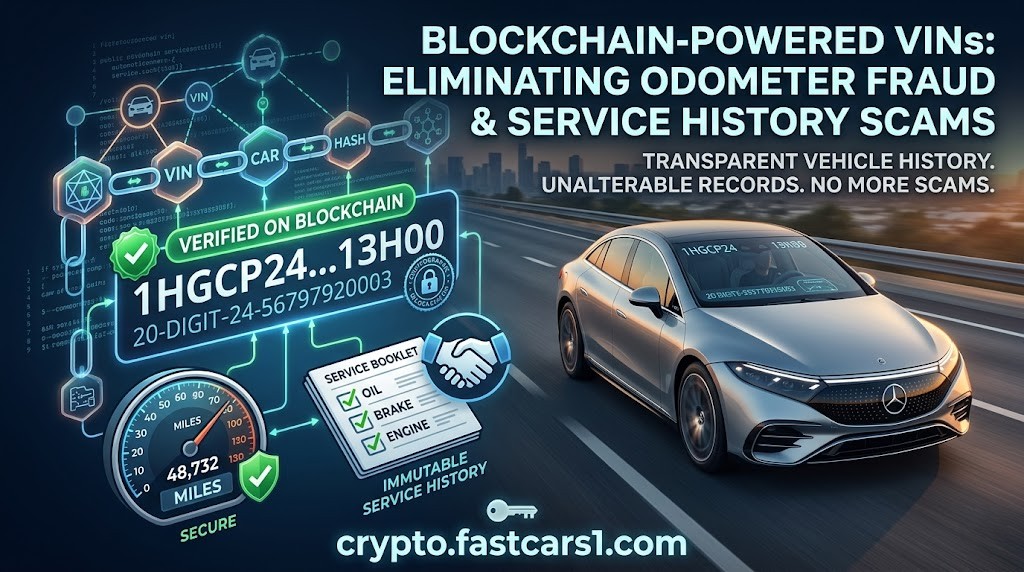
Blockchain-Powered VINs: Eliminating Odometer Fraud and Service History Scams.

In the used car market, trust is the most expensive commodity. For decades, dishonest sellers have relied on “odometer rollback” and “service book doctoring” to inflate the value of second-hand vehicles. According to industry reports, odometer fraud costs consumers billions of dollars annually, leading to unexpected maintenance costs and compromised safety.
However, the automotive industry is on the verge of a transparency revolution. By integrating Blockchain technology into the Vehicle Identification Number (VIN) system, manufacturers and regulators are creating an immutable, digital “DNA” for every car on the road.
1. The Vulnerability of Traditional VIN Systems
The current VIN system is essentially a static 17-digit code. While it provides a history via databases like Carfax or HPI, these databases rely on manual entries from various sources: dealerships, insurance companies, and police reports.
The weakness is simple: Human error and central databases. If a shady mechanic performs an oil change and “forgets” to log the mileage, or if a centralized database is hacked, the car’s history becomes unreliable. Odometer fraud is often as simple as plugging a small electronic device into a car’s OBD-II port to “clock back” the miles.
2. Enter the Blockchain VIN: A Digital Ledger of Truth
A blockchain-powered VIN transforms the car’s identity from a static number into a live, decentralized ledger. Every significant event in a car’s life becomes a “block” in its chain.
-
Immutable Records: Once a service, an accident, or a mileage reading is recorded on the blockchain, it cannot be deleted, altered, or overwritten.
-
Decentralization: The data is not owned by a single company. Instead, it is distributed across a network, making it nearly impossible for fraudulent sellers to “clean” a title or hide a salvage history.
3. How It Works in Real-Time
The power of this system lies in automation. In a blockchain-integrated automotive ecosystem:
-
The Factory: The car is born on the blockchain with its original specifications, paint code, and engine number.
-
The IoT Sensors: Modern vehicles are equipped with Internet of Things (IoT) sensors. These sensors can automatically transmit mileage and “engine health” data to the blockchain at regular intervals, bypassing human intervention.
-
The Service Center: When a car is serviced, the mechanic signs the entry with a digital signature. This proves exactly who worked on the car and when.
-
The Transfer: When the car is sold, the “Digital Title” is transferred from the seller’s wallet to the buyer’s wallet, ensuring a clear chain of ownership.
4. Eliminating the “Lemon” Risk for Buyers
For a buyer, the blockchain-powered VIN offers a “Trust Score” that is mathematically verified. Instead of taking a seller’s word, a buyer can scan a QR code on the car’s dashboard and instantly see:
-
True Mileage: Verified by multiple nodes (insurance, service centers, and IoT logs).
-
Accident History: Real-time updates from insurance smart contracts.
-
Parts Authenticity: Verification that only OEM (Original Equipment Manufacturer) parts were used in repairs.
This transparency effectively eliminates “Lemons” (defective cars) from the premium market, as any serious issue would be permanently visible on the digital ledger.
5. Benefits for Insurers and Lenders
It’s not just buyers who benefit. Insurance companies can use blockchain data to offer lower premiums to drivers with verified, consistent service histories. Similarly, banks and lenders can offer better financing rates because the “Resale Value” of the car is guaranteed by its transparent data.
In a world where data is the new oil, a “Clean Blockchain History” becomes a tangible asset that increases the car’s market value.
6. The Challenges of Global Adoption
While the technology exists, the challenge is Standardization. For this system to be truly effective, global manufacturers (like Volkswagen, Toyota, and GM) must agree on a unified blockchain protocol. Furthermore, privacy concerns regarding GPS data and owner identity must be balanced with the need for mechanical transparency.
As of 2026, several pilot programs in the EU and North America are already integrating “Digital Passports” for electric vehicles (EVs), focusing on battery health—a trend that is expected to expand to all internal combustion engine vehicles by the end of the decade.
Conclusion: The End of the Fraud Era
Blockchain-powered VINs are more than just a tech upgrade; they are a moral upgrade for the automotive industry. By removing the “Information Asymmetry” between the buyer and the seller, blockchain technology is finally putting the brakes on odometer fraud and service scams.
The future of car buying is one where you don’t have to “guess” if a deal is too good to be true—the ledger will tell you exactly what you’re buying.
